
CORNEAL ULCERS
What is an ulcer?

The cornea is the transparent structure which makes up the front of the eyeball. The cornea is comprised of three layers. The outer layer is called the epithelium, the centre called the stroma and the deepest layer is descemet’s membrane.
An ulcer is present if there is any loss of cells from the cornea. The depth of the loss of tissue determines how serious it is. Ulcers may be superficial and heal very quickly or may be very deep leading to potential rupture of the eye. Infections, ongoing trauma or incorrect drugs may cause an ulcer to get larger or deeper.
How do you get corneal ulcers?

Dogs: There are several causes of corneal ulcers. For dogs the most common is trauma such as rubbing at the eye, running into sticks or getting a foreign body under the eyelids such as a grass seed or from cat scratches. At times chemical burns occur if irritating shampoo gets in the eye. Conformational abnormalities may lead to corneal ulcers – for example the lids my roll inwards causing hair to rub on the eye or there may be excessive facial folds causing fur to rub on the eyes or the eyelids may not close over the eye itself correctly leading to drying and an increased risk of ulceration.
Primary infections (bacterial, viral infections or fungal) are not common in dogs. Disease elsewhere may affect the eye or there may be congenital abnormalities leading to eye problems. Examples include drying of the cornea due to abnormal tear production, called Keratoconjunctivitis Sicca (KCS or “dye eye”); and diseases of the endocrine system such as diabetes mellitus, Cushing’s Disease(hyperadrenocorticism), and hypothyroidism. At times neurological problems may lead to secondary eye changes for example if there is nerve damage.

Cats: Are very different to dogs. We see the same range of problems as with dog but the more common reasons why a cat may get an ulcer is from fighting injuries, other trauma and they more commonly will have infections.
The more nasty infections are due to bacterial agent such as mycoplasma and chlamydia but these rarely are associated with ulceration. The worst agent is Herpes which is one of the cat flu viruses. Herpes can cause sore eyes and either branching ulcer (called dendritic ulcers) or larger ulcers. Cats with Herpes or suspect Herpes require specific therapy. At this stage it is not recognised that feline herpes is transmissible to humans.
How painful is an ulcer?
Without a doubt corneal ulcers are incredibly painful. Dogs will hold the eye shut, rub the eye and exhibit reluctance to be touched and may even bite due to the pain. Generally there will be some form of discharge. Cats will exhibit the same signs but we also see swelling of the soft tissue and they are generally in a lot of pain.
How do we find out if a pet has an ulcer?
We use a special stain called fluorescein to highlight the presence of an ulcer. A drop of this stain is placed on the cornea and it adheres to areas of ulceration. To make this easier to see we use a UV light. At times we may need to check the tear production and also test the eye for elevated or low eye ball pressure. We will also use local anaesthetic to check for foreign bodies and check the eyelids for stray hairs. If there is a deep ulcer we may take a culture to determine what antibiotics are needed. In cats there are specific tests to see if Herpes is present but generally this is not done due to time and problems with the test itself – clinical judgment is used for each case.
Treatment

The size and depth and rate of change in the ulcer size will dictate how we treat and for how long.
Superficial ulcers (Corneal abrasions) generally heal within 3-5 days. Medication is used to prevent bacterial infections (antibiotic eye drops or ointment) and to lubricate the eye. We may apply drugs to reduce pain.
Deeper ulcers will be treated in the same manner but we will add in oral medication to reduce pain and inflammation and additional topical drugs may be required.
If there is deep ulcer (to the level of the inner membrane) then surgery is required to protect the weak area o the cornea as it is likely to rupture. If the eyeball ruptures it is difficult to save the eye.
Deeper ulcers or ulcers that are spreading and look discoloured will prompt us to collect material for culture as secondary infection is highly likely. Certain bacterial infections can cause the cornea to “melt” due o the destructive enzymes produced by the bacteria.
The treatment for cats will generally involve the use of topical and oral medication and if Herpes is part of the problem then specific oral anti0viral medication is used. If a Herpetic ulcer is present and it fails to heal then surgery is indicated to remove the surface layer of the cornea as this generally will bring about healing.
Follow-up checks are vital
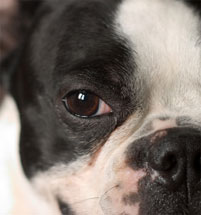
We always recommend that eye injuries are checked on a regular basis until healed. It is important that healing proceeds along at a reasonable pace and that it does not go backward. Your veterinarian is able to assess this accurately. At times even superficial ulcers do not heal and if this is found then there are surgeries that we perform to accelerate this process.
Once we are happy the ulcer is healed then we can tell you when to stop the medications.
As the ulcer heals you may see a cloudy area in the cornea corresponding o the injured area – this is due to disruption of the cells in the cornea and generally resolves with time. If there has been a deep ulcer you may see scarring and may see small blood vessels growing into the cornea. Once the healing is complete we may use some cortisone drops to reduce the scarring changes – this has to be done with care as it does delay corneal healing – it is never used whilst the ulcer is present.
Problems with medications
It is uncommon for the drugs to cause any problems. If we have applied atropine the effect of causing the pupil to dilate may last for about 5 days and during this time avoidance of sun exposure is advised
If you think a drug is causing your pet pain you should seek attention from your veterinarian.
Are there any side-effects from the eye medications?
As we are often using drugs you may see your dog sneeze, drool or swallow afterward – this is due to the drugs going down the tear ducts and the animal may then taste the medication.